Oshi Casino’s legal status in Australia
 Available in AU
Oshi operates a mixed fiat-and-cryptocurrency casino, but its overseas licensing details cannot be treated as permission to supply casino games in Australia. The central distinction is between a company appearing in a foreign gaming register and an online casino service being permitted to serve someone physically within Australia. Those are separate legal questions, with different regulators and different consequences if money is disputed.
The casino is associated with Novatrix SRL and the domain oshi.io. Its overseas registration history includes a Tobique licence-holder entry and a more specific Anjouan licence entry that names the domain. Australia applies its own Interactive Gambling Act 2001 to the supply of online casino services, regardless of the casino’s payment currency or the country named on a foreign certificate.
Table of Contents
- Online casino access under Australian law
- Where a payment complaint can go
- ACMA's record involving Oshi Casino
- Why the names Dama N.V. and Novatrix SRL both appear
- What the Tobique and Anjouan entries cover
- Gambling winnings and later crypto disposal
- Questions about Oshi's Australian legal position
- What the register entries do and do not protect
Online casino access under Australian law
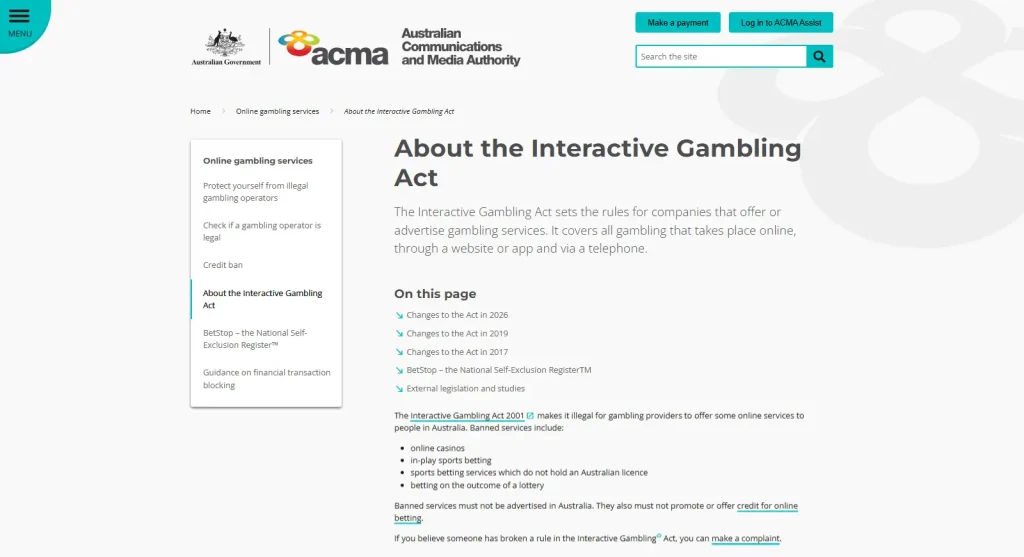
Oshi cannot lawfully supply online casino games to people physically located in Australia. Under the Interactive Gambling Act 2001, the Australian prohibition addresses the provision of specified interactive gambling services, including online casino games. An overseas casino licence does not override that prohibition. Offering an account balance in Australian dollars is likewise different from holding an Australian authorisation to supply an online casino.
The Australian Communications and Media Authority, or ACMA, is the federal agency responsible for enforcement under the Act. Australia distinguishes licensed interactive wagering services from prohibited online casino services. A licensed sports-betting business and a casino offering virtual slots or online roulette do not belong to the same regulatory category. The Australian register associated with permitted wagering services is not a route for authorising a foreign online casino.
The distinction also matters when reading the law from the customer’s side. The service-supply prohibition should not be casually recast as a claim that every individual player commits an offence simply by visiting a casino website. The provider’s legal position and a person’s own circumstances are different questions. Nor does a site displaying an Australian English locale change what an operator may lawfully supply in the country.
ACMA identifies prohibited services, can request internet service provider blocking and publishes consumer information about illegal gambling operations. Blocking and enforcement operate at a regulatory level; they do not confer individual repayment rights or validate any particular balance. A person comparing the product features described in the Oshi casino overview should keep that market-access question separate from the features of the games themselves.
Where a payment complaint can go
When a withdrawal or balance becomes disputed, the first useful distinction is between reporting a potentially illegal service and seeking a financial remedy. ACMA has a role in the first process. It accepts reports concerning illegal interactive gambling and acts under federal law. It does not operate as a payment tribunal empowered to settle each casino customer’s withdrawal dispute.
A customer seeking to clarify an existing transaction benefits from a coherent record: the transaction date and amount, original payment denomination, payment-provider reference, relevant account correspondence, any requested identity documents and the wording of the applicable terms. For a crypto transaction, the asset, destination address and transaction identifier can establish that a blockchain transfer occurred; they do not, by themselves, prove that a casino correctly credited a balance or that an operator owes a particular sum.
The practical route depends on the payment rail. A card payment can involve a card issuer’s dispute process, which has its own criteria and time limits. A bank transfer may call for contacting the sending bank promptly. A cryptocurrency transfer works differently: network settlement is commonly irreversible, so a blockchain transaction cannot be treated like a reversible card authorisation. None of these routes guarantees recovery. An overseas casino licence also cannot substitute for Australian consumer protections attached to locally permitted gambling products.
Oshi’s general product list includes cards, bank and e-wallet methods alongside BTC, BCH, ETH, LTC, XRP and USDT. The Oshi payment-method comparison explains how those mechanisms differ without treating a globally listed payment option as one that Australians may use. Payment method and licensing jurisdiction answer different questions: one explains how funds move, while the other describes the legal framework for the operator.
Account records can also matter. Oshi has identity-verification procedures, and documentation may be requested around withdrawals. The account verification and support guide explains the account controls and contact channels without implying that an offshore operator has an Australian complaint-resolution obligation.
ACMA’s record involving Oshi Casino
Oshi is specifically named in ACMA’s material about prohibited interactive gambling services. The regulator’s record is more concrete than a generic warning about offshore casino websites: it names the casino and includes historical enforcement connected with the brand.
During the October–December 2022 reporting period, ACMA issued a formal warning to Dama N.V. concerning prohibited online casino services that included Oshi Casino, Winning Days and 21Bit Casino. An Oshi-related address, oshi1.io, also appeared in the regulator’s historical internet service provider blocking material. That historical address should not be confused with the present canonical oshi.io domain or taken as a recommendation to use alternative addresses.
A warning is a regulatory action with a named addressee and a period in which it occurred. It is not a standing court finding about every later transaction at the casino, and it is not a statement that the brand’s current named legal owner received the same warning. ACMA’s investigation index separately identifies Oshi Casino among prohibited services. Together, those records establish the Australian regulatory context without requiring speculation about the operator’s current country-by-country access settings.
Australia’s 2026 gambling reforms have their own commencement timetable. The Interactive Gambling Amendment (Gambling Reform) Act 2026 received assent on 26 August 2026, with most changes commencing on 1 January 2027 according to ACMA. The underlying prohibition on supplying online casino services to Australians already exists under the Interactive Gambling Act; it does not depend on those later commencement dates.
For the consumer, ACMA’s record is best understood as a clear limit on the service’s Australian legal position. It should not be recast into a numerical safety score or an assurance that a financial complaint will be resolved. Regulatory enforcement, account conduct and third-party complaint mediation remain separate matters.
Why the names Dama N.V. and Novatrix SRL both appear
The name associated with a past enforcement notice is not necessarily the name given as a site’s current operator. The Australian notice concerns Dama N.V. in the 2022 reporting period. Oshi’s current website names Novatrix SRL, and that company appears in overseas gaming-license listings. Treating the two companies as interchangeable would misstate who was addressed by the Australian warning.
The cleanest way to understand the sequence is to keep each name attached to its specific context:
- Historical enforcement: ACMA’s 2022 action names Dama N.V. in connection with online casino services that included Oshi Casino.
- Current casino identity: the Oshi site at oshi.io names Novatrix SRL as the operator.
- Overseas register entries: the Tobique and Anjouan records identify Novatrix SRL, with the Anjouan entry also naming oshi.io.
A brand name can persist while its recorded corporate associations change. This is why a company name alone is insufficient to settle an older complaint or establish who controlled a given transaction on a particular date. A payment or account dispute needs the terms and corporate identity applicable to the transaction itself; the current footer does not automatically rewrite earlier records.
Novatrix’s Costa Rican company-registration information serves a different function. Company incorporation identifies a corporate registration jurisdiction. It is not a casino licence and it does not replace the laws of the market in which a service is offered. The distinction becomes especially important when a website presents several jurisdictions in nearby legal text: incorporation, licensing and permission to serve Australia are three different matters.
What the Tobique and Anjouan entries cover
Two separate overseas gaming records relate to Novatrix SRL. The Anjouan Gaming Authority licence register includes Novatrix SRL with B2C licence ALSI-202508056-FI2, issued on 25 August 2025 and with an expiry date of 24 August 2027. Its domain list expressly includes oshi.io. A domain-specific entry is materially different from a record that merely lists a company.
The Tobique Gaming Commission publishes Novatrix S.R.L. as a remote B2C licence holder, with a publicly listed expiry date of 13 March 2027. Oshi states that its Tobique e-gaming licence carries the number 0000002. The public Tobique licence-holder table lists the company and activity, while the site’s stated number and the individual oshi.io domain do not appear as matching fields in that public holder table. It is therefore accurate to identify the registered company without implying that the same table displays a domain-level certificate.
| Jurisdiction or record | Named company and scope | Match to Oshi | Australian implication |
|---|---|---|---|
| Anjouan Gaming Authority | Novatrix SRL, B2C, licence ALSI-202508056-FI2; expiry 24 August 2027 | oshi.io appears in the licence’s domain list | An overseas domain entry does not authorise Australian online casino supply |
| Tobique Gaming Commission | Novatrix S.R.L., remote B2C holder; expiry 13 March 2027 | Holder-level company listing; Oshi states licence number 0000002 separately | A foreign holder listing does not alter the Australian prohibition |
| Costa Rican corporate registration | Novatrix SRL’s place of company incorporation | Corporate registration, not a gaming-licence match | Company registration is not Australian casino authorisation |
| Australian legal framework | Interactive Gambling Act 2001; ACMA enforcement | Online casino supply is prohibited for people physically in Australia | No Australian permission to supply Oshi’s online casino service |
The table answers several common questions without collapsing different kinds of record into a single “licensed or unlicensed” label. The Anjouan entry connects a licence to the exact domain; the Tobique public holder table connects a company to a licence-holder category; Costa Rican incorporation connects the company to a corporate registration. None of those overseas entries supplies the missing Australian legal permission.
Similarly, a licence’s expiry date describes the outer term shown by that particular register. It is not an assurance that all activities are approved in every market until that date. Permission to operate remains jurisdiction-specific, and regulatory conditions or restrictions can differ from country to country.
The difference is consequential in a dispute. A register may help identify which company or licensing body to address about a complaint within its jurisdiction. It cannot make ACMA an individual payout arbitrator, and it cannot transfer Australian consumer safeguards for locally permitted gambling products to an online casino that Australians cannot lawfully be offered.
Gambling winnings and later crypto disposal
Australian taxation is a separate issue from the legal right to supply a gambling service. The Australian Taxation Office generally treats casual, non-business gambling winnings as non-assessable income. That general treatment depends on the circumstances: gambling conducted as a business can raise a different tax analysis, and no result follows simply from a casino’s overseas location.
Cryptocurrency introduces a second possible tax event. If crypto received as winnings is subsequently held as an investment and later sold, exchanged or otherwise disposed of, capital gains tax considerations can arise. The relevant value, acquisition circumstances and later transaction matter. The initial receipt of gambling winnings and a later disposal of a crypto asset are distinct events, so an assumption about one should not be carried over to the other.
Consider a straightforward example without assigning any particular amount to Oshi: a person receives a crypto asset and keeps it after the underlying transaction. A later sale at a different Australian-dollar value is a different event from the receipt itself. Any tax outcome depends on that person’s facts and the ATO rules that apply to them; a registered Australian tax practitioner can advise on records, classification and reporting.
Tax treatment does not legalise the supply of a prohibited online casino service. Likewise, a foreign gaming licence does not settle Australian tax questions. Keeping gambling law, individual tax circumstances and crypto-asset transactions in their own categories makes each issue easier to assess.
Questions about Oshi’s Australian legal position
Can Oshi lawfully supply online casino games to people in Australia?
No. The Interactive Gambling Act 2001 prohibits supplying online casino services to people physically in Australia. Oshi’s overseas licence entries do not change that Australian rule.
Does the Anjouan licence entry include the oshi.io domain?
Yes. The Anjouan Gaming Authority lists Novatrix SRL under licence ALSI-202508056-FI2 and includes oshi.io among its B2C operator domains. That entry is an overseas licence record, not Australian permission.
Did ACMA take enforcement action involving Oshi Casino?
Yes. In the October–December 2022 reporting period, ACMA issued a formal warning to Dama N.V. concerning prohibited online casino services that included Oshi Casino. The action concerned Dama N.V. at that time, not the casino’s current named operator Novatrix SRL.
Does ACMA decide individual Oshi withdrawal disputes?
No. ACMA receives reports about illegal interactive gambling services and enforces Australian federal gambling law; it is not an individual casino-payment dispute tribunal. A customer seeking a financial remedy needs to consider the relevant payment provider and applicable dispute process.
What the register entries do and do not protect
Oshi’s current operator, Novatrix SRL, is associated with two different overseas licensing records. The Anjouan entry is particularly specific because it lists oshi.io; the Tobique record identifies the company as a B2C holder while Oshi separately states its Tobique licence number. These details help identify the operator and the relevant overseas bodies, but they have no power to convert the casino into an Australian-authorised online gambling service.
ACMA’s Oshi-specific history gives the Australian position its own documentary footing, including the 2022 warning addressed to Dama N.V. The key practical distinction is between tracing a casino’s corporate and licensing identity and having an enforceable route for an individual financial claim. Those tasks require different information and may involve different institutions. For someone facing a payment or account dispute, careful transaction records and the appropriate payment-provider process matter more than the presence of a foreign licence number alone.